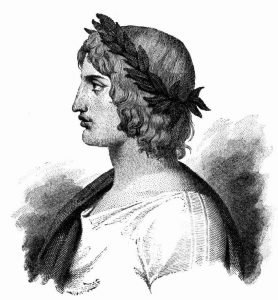
Publius Vergilius Maro

70BC - 19BC

Virgil

Virgil was born in 70 BCE. Like Catullus, according to ancient commentators, he came from the North, near Mantua. His was a family of farmers, reasonably prosperous, to judge from his upbringing, but lower in the scale of wealth and social position than Catullus. He had a thorough education, reportedly studying Greek, Epicurean philosophy and rhetoric at Cremona, Milan and Naples.

Virgil

The first of the three works for which he is famous was the Eclogues, written around 40 BCE. These are shortish poems about shepherds and shepherdesses, which follow an established Greek poetic form, but also refer to contemporary events, when land was being confiscated in the area around Mantua to give to soldiers who had fought in the victory over Brutus and Cassius at Philippi in 42 BCE. Commentators tell us that the local Governor, Pollio, to whom Virgil dedicated the Eclogues, had taken an interest in him which resulted in an introduction to Octavian (the future Emperor Augustus), the salvation of Virgil’s family farm from the confiscations, and Virgil’s arrival in the circle of Maecenas, the greatest artistic patron of the age and a senior political aide to Octavian.

Virgil’s reputation was consolidated during the thirties BCE by his composition, at Maecenas’s suggestion, of four books of Georgics, poetry about agriculture, again an established theme from Greek poetry. He then moved on to the Aeneid, his great historical epic poem. The poem tells the story of Aeneas, a Trojan prince who was the son of a mortal father and a divine mother, Venus, the Goddess of love. With her help, Aeneas escapes from the sack of the city at the end of the Trojan War, carrying his aged father on his shoulders. With a group of comrades, he travels the Mediterranean, looking for a new home. As the poem starts, his father has recently died and he has just landed in North Africa near Carthage, newly founded by Queen Dido.

He is kindly received, and tells his story so far in flashback. He and Dido fall in love, and for a time it looks as though he may stay in Carthage. Then the God Mercury arrives, reminds him that an oracle has told him that he will found a new land in the West and tells him to get on with it. He reluctantly does as he is told: deserted, Dido kills herself. After further adventures in Sicily, Aeneas sails to Italy, where a prophetess helps him to pay a visit to the underworld. There he is shown great Romans-to-be, a line culminating in the Emperor Augustus and his imperial house.

After returning from Hades, Aeneas moves on to Latium, the region where Rome will eventually stand. A succession of events involving diplomacy, intrigue, jealousy and betrayal leads to war between the Trojans and the Rutuli, a local people led by their King Turnus, and their respective allies. The epic ends with Aeneas killing Turnus in single combat, leaving the way clear for the future foundation of Rome.

The Aeneid is a mammoth undertaking: an attempt to use poetry to dignify the origins and achievements of Rome, and assert the divine origins, not only of Augustus himself, but also of his political project for a new age. It succeeds. As epic poetry, it adopts the literary form most highly respected in the ancient world, suited for describing the greatest of deeds and the greatest of heroes.

The poem adopts the same metre as that used for the greatest Greek epics, the Iliad and the Odyssey, composed many centuries before, and draws many parallels between their heroes and Aeneas. Virgil is claiming the authority of Homer, the supreme poetic authority of the ancient world, while working in his own new, highly sophisticated, and very Roman, style. No wonder that, in antiquity, Virgil remained the most famous and highly-regarded Roman poet. He died in 19 BCE.

No contemporary copies of these Latin poets’ work survive, so we are lucky to have them. Find out more here.

Poetry by Virgil

  1. Virgil predicts a forthcoming birth and a new golden age
  2. The Aeneid begins
  3. Juno’s anger
  4. Storm at sea!
  5. Jupiter’s prophecy
  6. Dido’s story
  7. Venus’s swans
  8. The Trojans reach Carthage
  9. Aeneas and Dido meet
  10. Dido and Cupid
  11. Aeneas prepares to tell Dido his story
  12. Laocoon warns against the Trojan horse
  13. What is this wooden horse?
  14. Laocoon and the snakes
  15. The Trojan Horse enters the city
  16. The Trojan horse opens
  17. Hector visits Aeneas in a dream
  18. Aeneas prepares for a hopeless fight
  19. Into battle
  20. Cassandra is taken
  21. The battle for Priam’s palace
  22. The death of Priam
  23. Helen in the darkness
  24. Venus speaks
  25. Aeneas rescues his Father Anchises
  26. Aeneas saves his son and father, but at a cost
  27. How Aeneas will know the site of his city
  28. The Harpy’s prophecy
  29. Dido falls in love
  30. Dido and Aeneas: royal hunt and royal affair
  31. Rumour
  32. Mercury’s journey to Carthage
  33. Dido and Aeneas: Hell hath no fury …
  34. The Trojans prepare to set sail from Carthage
  35. Dido’s release
  36. The boxers
  37. Fire strikes Aeneas’s fleet
  38. Anchises’s ghost invites Aeneas to visit the underworld
  39. Palinurus the helmsman is lost
  40. The Sibyl’s Prophecy
  41. Aeneas learns the way to the underworld
  42. The journey to Hades begins
  43. Charon, the ferryman
  44. Aeneas finds Dido among the shades
  45. Aeneas comes to the Hell of Tartarus
  46. Souls awaiting punishment in Tartarus, and the crimes that brought them there.
  47. Aeneas reaches the Elysian Fields
  48. Aeneas’s vision of Augustus
  49. Aeneas sees Marcellus, Augustus’s tragic heir
  50. The portals of sleep
  51. Omens for Princess Lavinia
  52. Aeneas arrives in Italy
  53. In King Latinus’s hall
  54. King Latinus grants the Trojans’ request
  55. A Fury rouses Turnus to war
  56. The Fury Allecto blows the alarm
  57. Juno throws open the gates of war
  58. Help for Father Aeneas from Father Tiber
  59. Aeneas tours the site of Rome
  60. Vulcan’s forge
  61. New allies for Aeneas
  62. The shield of Aeneas
  63. Turnus the wolf
  64. Aeneas’s ships are transformed
  65. The death of Euryalus and Nisus
  66. Turnus at bay
  67. Sea-nymphs
  68. Aeneas joins the fray
  69. The death of Pallas
  70. Turnus is lured away from battle
  71. King Mezentius meets his match
  72. Mourning for Pallas
  73. Rites for the allies’ dead
  74. The infant Camilla
  75. Aeneas’s oath
  76. Aeneas is wounded
  77. Juno is reconciled
  78. The death of Turnus
  79. Virgil begins the Georgics
  80. The farmer’s starry calendar
  81. Signs of bad weather
  82. Catastrophe for Rome?
  83. The farmer’s happy lot
  84. More from Virgil’s farming Utopia
  85. Virgil’s poetic temple to Caesar
  86. The natural history of bees
  87. Love is the same for all
  88. Aristaeus’s bees
Privacy Overview

This website uses cookies so that we can provide you with the best user experience possible. Cookie information is stored in your browser and performs functions such as recognising you when you return to our website and helping our team to understand which sections of the website you find most interesting and useful.